If law enforcement wants to question you, the most important thing to understand is this:
You are not required to speak to the police. Not during a traffic stop. Not at your home. Not at the station. Not “just to clear things up.”

If law enforcement wants to question you, the most important thing to understand is this:
You are not required to speak to the police. Not during a traffic stop. Not at your home. Not at the station. Not “just to clear things up.”
The legal rules governing interrogations come primarily from constitutional law — especially the Fifth and Sixth Amendments — and landmark U.S. Supreme Court decisions including:
Understanding how these rules work — and when they apply — is critical.
Under Miranda v. Arizona, when a person is subjected to custodial interrogation, law enforcement must advise them of their rights:
If police question someone in custody without giving these warnings, the statements may be suppressed. However — and this is critical — Miranda only applies when two things are present:
If either element is missing, Miranda warnings are not required. A peace officer does not have to advise a person of their Miranda rights while they’re investigating a case in the field. Miranda attaches only when a person is in a custodial interrogation (this typically means they’re already arrested and being questioned about the subject matter for which they were arrested).
Under Rhode Island v. Innis, interrogation includes:
Officers do not have to ask direct questions. Subtle prompts can qualify.
But casual conversation, booking questions, or spontaneous statements may not.
A consensual encounter occurs when:
You have no obligation to answer questions. You can walk away. Miranda does not apply because you are not in custody.
A detention occurs when:
Examples include traffic stops or investigative stops.
You must comply with lawful commands, but:
Custody occurs when a reasonable person would not feel free to leave and the restraint resembles formal arrest.
Common examples:
This is where Miranda protections apply.
The law has evolved. Under Edwards v. Arizona, once a person clearly invokes their right to counsel:
However, under Davis v. United States, the request must be clear and unambiguous.
Saying:
Clear language matters. Examples of clear invocation:
Once invoked, questioning should cease.
This is true in almost every situation. You are not required to:
There is no legal obligation to answer investigative questions. Remaining silent cannot legally be used as evidence of guilt in most custodial contexts.
Making a statement after already being arrested is almost always a terrible idea. There are a dozen reasons why which are best discussed in person with your attorney.
Police are trained interrogators. Interrogations are designed to:
Even truthful statements can:
Once a statement is recorded, it cannot be undone. Early silence protects options and avoids mistakes.
In many cases, the strongest evidence is the defendant’s own words. It’s often times not physical evidence or forensic proof. The accused statements fill gaps in investigations and assist in further evidence gathering. Remaining silent forces the prosecution to prove its case independently.
Police often request “voluntary” interviews at the station.
These may not feel voluntary — but if you are free to leave, Miranda may not apply. You can decline or ask to have your attorney present.
You must provide identification and registration, but you are not required to answer investigative questions about alleged criminal conduct.
Juveniles also have Miranda rights, but courts evaluate whether the waiver was knowing and voluntary with greater scrutiny. Parents do not automatically invalidate statements, but their presence can affect admissibility.
If statements are obtained in violation of Miranda:
However:
Miranda violations are not automatic case dismissals — but they can materially weaken the prosecution.
Once formal charges are filed, the Sixth Amendment right to counsel attaches.
After that point, police cannot deliberately elicit statements about the charged offense without counsel present.
This protection is separate from Miranda.
During police questioning in California:
Miranda protections apply only during custodial interrogation — but your right not to speak exists at all times.
In most situations, speaking without an attorney present creates risk and rarely provides benefit.
Silence preserves leverage.
If you or a family member has been contacted by law enforcement or questioned about a criminal investigation in California — and you want a defense review focused on custodial status, Miranda issues, and how prior statements may affect exposure — you can send your information to me here:

Criminal Defense Overview
A California criminal case does not move in one straight line. Cases begin with an investigation or arrest, but many never reach trial. Some are rejected before filing. Some resolve at arraignment. Some felony cases are narrowed or dismissed at the preliminary hearing. Others proceed all the way through jury trial.
Still, there is a classic path. If you understand that path, it becomes much easier to understand what is happening in your own case and why timing, charging decisions, and defense strategy matter so much for the fate of a case.
This page is my attempt to illustrate the usual lifecycle of a California criminal case from arrest through jury trial and to highlight the major differences between misdemeanor and felony procedure.
more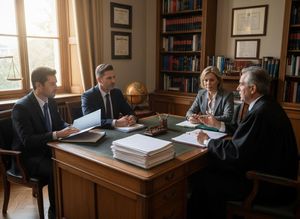
If you are charged with a felony in California, one of the major events in the case is the preliminary hearing (aka “The Prelim”). This hearing is not the trial. No jury decides guilt or innocence there. Instead, a live-testimony hearing is held and the judge decides whether the prosecution has shown enough evidence to keep the case moving forward and justify a jury trial.
A preliminary hearing can matter a great deal. It can expose weaknesses in the case, lock witnesses into testimony, narrow issues, support later motions, and sometimes result in charges being dismissed or reduced. It can also be a tactical trap if the defense gives away too much too early.
more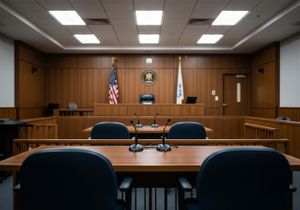
An arraignment is the first formal court appearance after criminal charges are filed. It is the stage where:
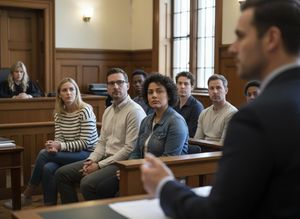
A jury trial is the stage of a criminal case where the prosecution must finally prove its case beyond a reasonable doubt to a group of citizens. It is the highest burden in the legal system—and the one that actually decides guilt or innocence.
Everything that comes before it—arrest, charging, arraignment, pretrial motions, and even the preliminary hearing—is about whether the case can proceed to this stage. The jury trial is where the case is won or lost.
If you are facing criminal charges in California, understanding how a jury trial actually works—and how it is different from everything leading up to it is critical.
more